
INSIGHT DEC 19, 2024
Microclimate Modelling: Shaping Sustainable and Resilient Urban Futures
In the quest for more sustainable and resilient urban environments, microclimate modelling has emerged as an invaluable tool. This sophisticated approach to urban planning and design leverages detailed simulations to understand and predict the microclimatic effects of urban developments, infrastructure, and landscaping. By integrating microclimate considerations into the early stages of urban planning and architectural design, cities can enhance comfort, sustainability, and resilience against climate change impacts. This comprehensive article explores the potential of microclimate modelling, underscoring its critical role in creating urban spaces that harmonize with their natural surroundings.
Understanding Microclimate Modelling
Microclimate modelling refers to the simulation of climatic conditions at a localized scale, typically around buildings, streets, and urban green spaces. These models consider various factors, including solar radiation, wind flow, humidity, and temperature, to predict how urban forms and materials will interact with natural weather patterns. The goal is to identify strategies that can mitigate adverse conditions (such as urban heat islands and poor air quality) and enhance the livability and sustainability of urban areas.
The Importance of Microclimate in Urban Planning
Urban areas are characterized by their unique microclimates, influenced by the density of buildings, materials used, and the scarcity of natural landscapes. These man-made environments can significantly alter temperature, airflow, and solar exposure, leading to challenges such as heat stress, increased energy demand for cooling, and diminished outdoor comfort. Microclimate modelling provides a window into these complex interactions, offering insights that can guide more informed decisions in urban design.
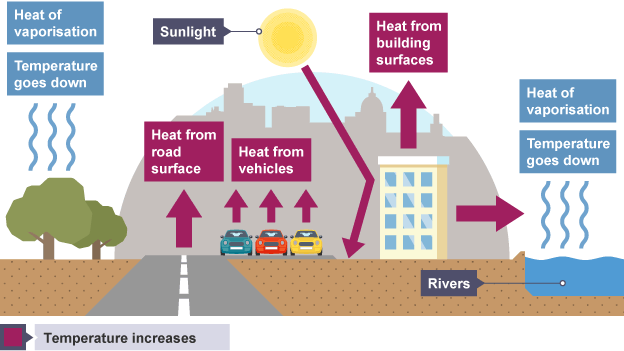
The impact of microclimate in urban areas @bbc
Enhancing Sustainability and Comfort
Microclimate modelling is a powerful ally in the pursuit of sustainable urban development. By understanding and manipulating the microclimate, urban planners and architects can devise solutions that naturally regulate temperature, enhance ventilation, and maximize natural lighting, thereby reducing reliance on mechanical heating, cooling, and lighting systems.
Strategies Informed by Microclimate Modelling
• Optimized Building Orientation and Design: Modelling can inform building orientation and design that maximizes natural ventilation and daylight while minimizing solar heat gain during hot months.
• Effective Use of Green Infrastructure: Strategic placement of green spaces, green roofs, and vertical gardens can cool urban areas, improve air quality, and enhance biodiversity.
• Innovative Material Selection: The selection of materials with suitable thermal properties or reflective capabilities can reduce heat absorption and storage, mitigating the urban heat island effect.
Boosting Resilience Against Climate Change
As cities grapple with the impacts of climate change, including rising temperatures and more frequent extreme weather events, microclimate modelling becomes an essential tool for resilience planning. It enables cities to assess vulnerability to heatwaves, flooding, and other climate-related risks and to implement adaptive strategies that protect urban communities and infrastructure.
Applications for Climate Adaptation
• Urban Cooling Solutions: Identifying areas for targeted cooling interventions, such as increased tree canopy cover or the creation of cool corridors.
• Flood Mitigation: Designing landscapes that facilitate stormwater absorption and runoff management, reducing flood risk.
• Enhanced Outdoor Comfort: Creating comfortable outdoor environments that encourage active transportation and reduce heat-related health risks.

Climate Mitigation & Climate Adaptation @adaptation.scot
Challenges and Opportunities
While microclimate modelling offers profound insights, its effectiveness is contingent on the availability of detailed environmental data, sophisticated modelling tools, and interdisciplinary collaboration. Advances in technology, including the use of sensors, satellite imaging, and machine learning, are expanding the possibilities for accurate and comprehensive microclimate analyses.
The integration of microclimate considerations into urban policy and planning represents both a challenge and an opportunity. As awareness grows, there is potential for regulatory frameworks to increasingly mandate microclimate assessments in the development process, ensuring that urban projects contribute positively to the local microclimate and broader environmental goals.
Conclusion: The Future of Urban Environments Shaped by Microclimate Modelling
Microclimate modelling stands at the forefront of innovative urban planning and design, offering a pathway to more sustainable, comfortable, and resilient cities. By harnessing detailed simulations to understand and optimize the interactions between urban forms and the natural environment, planners and architects can mitigate adverse microclimatic effects and enhance the quality of urban life. As we face the challenges of climate change and urbanization, the strategic application of microclimate modelling becomes ever more crucial in guiding our cities towards a sustainable and resilient future.
How ECOBUILD Can Help?
At ECOBUILD, we recognize the transformative potential of microclimate modelling in urban planning and design. Our expertise in sustainable development and environmental analysis enables us to provide comprehensive microclimate modelling services, helping clients navigate the complexities of urban design with sustainability and resilience in mind. Let ECOBUILD be your partner in leveraging the power of microclimate modelling to create urban environments that are not only sustainable and resilient but also conducive to the well-being of their communities.